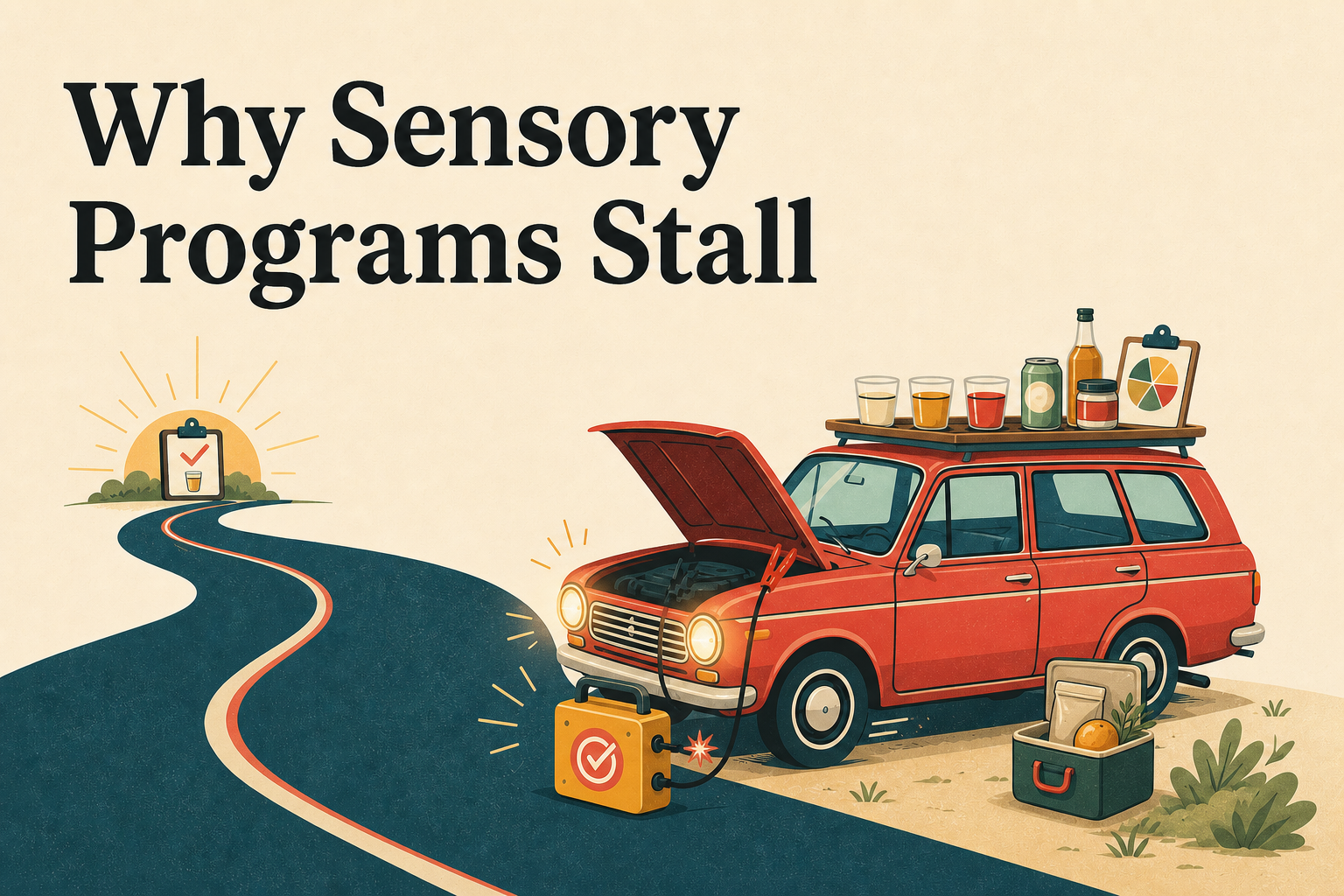
The weekly tasting used to fill up quickly. Now the calendar invitation sits unanswered. Samples are still evaluated, but less consistently, and the results do not generate the same discussion they once did.
Nothing dramatic caused the change. The company simply kept moving. Products, responsibilities, and priorities evolved while the sensory program stayed mostly the same.
When a program loses momentum, the answer is not necessarily to push harder. It may be time to reconsider what the program is being asked to do and how it fits into the organization today.
The program is no longer tied to a clear decision
Consider the difference between these two goals:
“We should taste every batch.”
“We need to identify batches that are not true to target before release.”
The first describes an activity. The second identifies a decision the tasting needs to support.
That distinction affects everything from the samples and tasters to the questions being asked. Testing an ingredient substitution, monitoring batch consistency, and evaluating shelf life all require tasting, but they do not require the same approach.
Programs can lose this focus gradually. A useful evaluation gains an extra question, then another product, then an additional rating scale. Each change makes sense on its own, but the overall tasting becomes longer and the results become harder to interpret.
Returning to the decision gives the program a clearer job. Once the team agrees on what it needs to learn, it can choose the simplest tasting approach that provides a useful answer.
What motivates tasters has changed
At the beginning of a sensory program, participation can be easy to generate. The goal is clear, the program is new, and employees are excited to contribute.
As the company grows, those same tasters may take on more responsibilities. Tastings begin competing with production work, meetings, and other priorities. Participation can decline even when employees still care about the program and the products.
Supporting participation at this stage may mean providing dedicated time, setting clear expectations, reinforcing the program through managers, and showing tasters how their feedback was used. These practical signals make it clear that tasting is a valued part of their work.
What motivated a small, closely connected team may not work the same way once roles become more specialized and schedules become more demanding.
The value is not always visible
Panelists and stakeholders are more likely to support a sensory program when they can see how the information is being used.
Sometimes the connection is obvious. A panel flags an unusual batch, the team investigates, and an issue is corrected. In other cases, the value is quieter. Tastings confirm that a process change did not affect the product, help a development team choose between prototypes, or build a record of normal product variation.
If those outcomes are not shared, sensory can begin to feel like another data collection exercise.
The results may also be communicated in a format that is useful to the sensory team but difficult for other groups to act on. Most decision-makers need a straightforward summary:
- What did the panel find?
- Why does it matter?
- What decision does the result support?
- What happens next?
Tasting data does not make the decision. It gives the team information that may be difficult to gather another way. Making that connection visible helps everyone understand the program's role.
It also helps panelists stay engaged. When people learn that their feedback supported a release decision, confirmed a product improvement, or helped resolve a question, their participation feels more meaningful.
Build around what the team needs now
Getting a sensory program moving again does not require solving every problem at once. Start with the most obvious need facing the team today. That might be improving batch-release decisions, evaluating a recurring product issue, or bringing more structure to development tastings.
- Choose one need. Focus on a question that comes up regularly and has a clear impact on the business.
- Make it repeatable. Use a tasting approach the team can run consistently with the time and tasters available.
- Build from there. Once the process is producing useful information, expand it where the next need becomes clear.
Momentum can begin with one tasting that answers the right question. Let the program grow from that success.
This focused reset allows the program to evolve with the organization while preserving what already works. The goal is not to build the largest or most sophisticated program, but one that continues to answer important product questions as the organization grows.