Our senses work a little like measuring devices. We constantly take in information from the outside world and use those impressions to describe what we experience. But our senses also have limits.
For flavor compounds, there is usually a minimum concentration needed before a person can detect, recognize, or describe what is present. Those points are known as sensory thresholds.
Threshold questions come up often in panelist training, quality control, and data analysis. They can be valuable, but they can also become slippery. Thresholds change by person, context, method, and repeated exposure, so measuring them well takes more care than simply adding a flavor spike and asking whether someone noticed it.
Why sensory thresholds are not fixed
A threshold is not a permanent value for a compound or a person. It is a moving point between not perceiving something, barely detecting it, recognizing it, and experiencing it clearly.
Fatigue, attention, recent exposure, sample matrix, serving order, individual sensitivity, and training can all change what someone notices. Even the act of testing for a threshold can shift perception because the panelist is repeatedly exposed to the same compound.
That does not mean thresholds are useless. It means they should be measured and interpreted with a clear purpose.
When threshold testing is useful
Threshold work is most useful when the sensory question depends on detecting a compound at a very low level. Contaminants are a common example, especially when a compound can reduce product acceptability or signal a safety, quality, or process issue.
Natural gas is a useful everyday example. Because natural gas is odorless, a strong-smelling compound is added so people can detect leaks. The added odor is dosed above typical detection levels so it can be noticed before the situation becomes dangerous.
Food and beverage teams may use similar thinking for off-flavors, taints, process markers, or raw material problems. The question is not always "What is the lowest possible level anyone can detect?" More often, it is "At what level does this become meaningful to our product, panel, or consumer?"
Three types of sensory thresholds
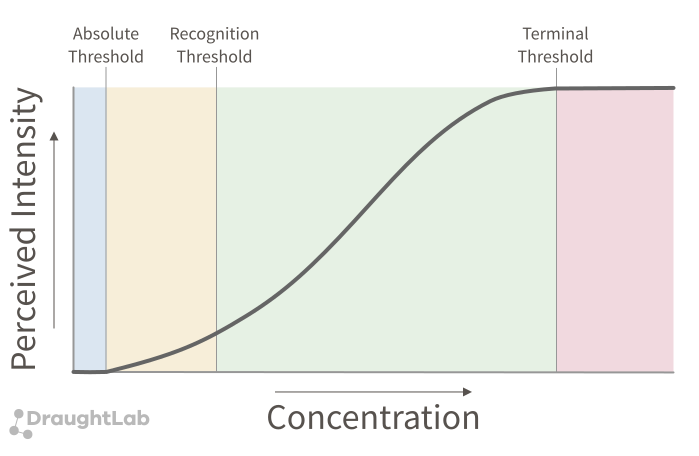
When discussing thresholds, three definitions are especially useful:
- Absolute threshold: the lowest concentration where a person can detect that something is present, even if they cannot identify what it is.
- Recognition threshold: the concentration where a person can detect a difference and correctly identify the stimulus, such as calling a sample mildly sweet or smoky.
- Terminal threshold: the point where increasing concentration no longer increases perceived intensity. Above this point, the experience may become overwhelming or painful.
How sensory thresholds are measured
There are several ways to measure sensory thresholds, but many programs use a method of limits approach. Panelists are presented with samples at ascending or descending concentrations, often using a three alternative forced choice test. The process is repeated several times, and the results are used to estimate an individual or group threshold.
This kind of work can require many samples, careful preparation, repeated sessions, and sometimes expensive flavor spikes. It can be worth doing when the question is important enough, but it is rarely the simplest option.
Do you need to measure thresholds?
Many sensory questions do not require threshold testing. If a team is managing an off-flavor that affects product acceptability, the most useful target may be the consumer's experience rather than the lowest level an internal expert can detect.
In that case, a trained internal panel does not need to find the absolute lowest concentration possible. It needs to identify the issue at a level below where customers are likely to notice or reject the product. Basic flavor training, consistent panel practice, and clear decision rules can often create more value than a complex threshold study.
Use thresholds when they create value
Sensory thresholds are powerful when they answer the right question. They can support contamination work, reference training, ingredient studies, and product-quality decisions where low-level perception matters.
They can also consume time and budget if the method is disconnected from a practical decision. Before launching a threshold study, define what the result will change. For many teams, structured sensory training and quality-control tasting will provide a clearer return than measuring at the edge of perception.