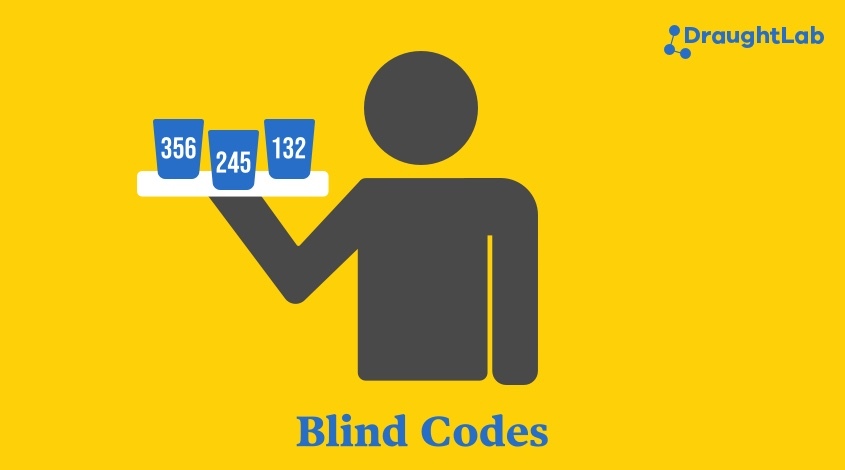
Managing bias is one of the harder parts of running a sensory panel. Product names, batch numbers, packaging dates, and even serving order can shape expectations before a taster ever evaluates the sample.
Serving samples blind helps reduce that risk, but blind service creates its own practical problem: the team still has to know which sample is which. Blind codes solve that problem by giving each sample a neutral label that keeps tasters from seeing biasing information.
When should you use blind codes?
Use blind codes when sample identity could influence feedback or when there is a realistic chance that a taster could receive, choose, or record the wrong sample. The more samples, panelists, test orders, or randomized serving plans involved, the more valuable blind codes become.
Blind codes are especially useful for difference tests, product comparisons, shelf-life checks, line trials, supplier comparisons, and any quality-control tasting where the result needs to be protected from expectation bias.
What are 3-digit blind codes?
A 3-digit blind code is a randomized number assigned to a sample. Instead of labeling cups as Product A or Product B, each serving vessel gets a neutral code such as 356, 245, or 132.
This approach is common in formal sensory work because it anonymizes the sample, hides obvious patterns, and makes it harder for panelists to infer the answer from another ballot or serving order. It is the strongest option when your test needs to support high-confidence product decisions.
The tradeoff is effort. Someone has to generate the codes, connect each code to the correct sample, label the serving vessels, and keep the ballot logic straight. For larger studies, structured tasting software can help manage those logistics.
When are short codes enough?
Short codes, such as A, B, C or 1, 2, 3, are easier to manage and can work well for simple tastings. If you are running an informal internal tasting or asking tasters to match a coded sample to the same code on a ballot, short codes may be enough.
The risk is that short codes can reveal structure. In some methods, the code itself gives away too much about what the taster is supposed to find. That is why short codes should be used carefully when the test design depends on hidden sample identity or randomized presentation.
Blind codes for triangle tests
Triangle tests are a good example of where blind coding matters. In a triangle test, tasters receive three samples and identify the one that is different. If the samples are labeled A, A, and B, the answer is visible before tasting begins.
Full individual blind coding is the cleanest approach, but teams can sometimes reduce the workload by assigning multiple codes to each product. For example, two codes can represent Sample A and two codes can represent Sample B, allowing the team to reuse codes without exposing sample identity to tasters.
Balance rigor with panel workload
Blind coding is valuable, but it should fit the stakes of the tasting. A research-grade test, a major production decision, or a customer-facing claim may justify full 3-digit blind codes. A quick screening session may not.
The goal is to protect the validity of your results without burying the panel leader in unnecessary logistics. If your team is spending more time managing codes than learning from the tasting, it may be worth adjusting the method, simplifying the sample set, or using better tools to manage the process.
A practical blind-code checklist
- Decide whether the tasting needs full 3-digit blind codes or simpler short codes.
- Create a code key that maps each blind code to the correct sample.
- Keep the code key away from tasters until the test is complete.
- Randomize serving order when the method requires it.
- Label cups, trays, and ballots consistently so samples cannot be mixed up.
- Review the setup before service, especially for triangle tests and larger panels.
Use blind codes to reduce bias, not create busywork
Blind codes are one of the simplest ways to make a sensory test more trustworthy. They help keep tasters focused on the product experience instead of the information surrounding the sample.
For teams building repeatable tasting workflows, structured sensory software can make blind coding, sample tracking, and panel logistics easier to manage without losing sight of the actual product decision.